After careful consideration and comments from colleagues and geography experts I have decided to go with my initial decision and announce the winner of the 2014 Geogarific Infographic Competition!
Here is a summary of the key points you need to know about tsunamis for GEOG3, check out the video below which is some raw footage of the Japan tsunami to give you an idea of the time scale and destruction involved. It's hard to imagine how long the waves are actually moving inland for, scary!
• A tsunami is a series
of waves, called a wave train, which can be up to 100km long and 1 hour apart. • These waves can reach
heights of 30meters, although most of them are no more than 3 meters • About 80% of tsunamis
happen within the “Ring of Fire”. They are usually caused by underwater
earthquakes when the ocean floor rises at a plate boundary and displaces the
water above it. • They have also been know to be caused by
underwater landslides, volcanic eruptions or meteorites impacts. • They race across the
sea at up to 500 miles an hour and can cross the entire Pacific Ocean in less
than a day while their long wavelengths mean they lose very little energy along
the way. • In deep ocean,
tsunami waves may appear only a foothigh but as they approach the shore shallow water slows them down and
the tops of the waves move faster than the bottoms so they grow in energy and
height. • A tsunami’s trough,
the low point beneath the crest, often reaches shore first, producing a vacuum
effect that sucks coastal water seaward exposing harbours and sea floors. • Flooding can extend 10 miles inland, lifting giant boulders, flipping vehicles and demolishing
houses.
Japan is a nation that has grown rapidly in the last few
decades, both economically and socially. During its development Japan invested
well in technology and is now one of the biggest technology exporting countries
in the world today. Moreover it has managed to achieve this despite being in an
area of the world that is riddled with environmental hazards.
One of the most hazardous
is the threat of a major earthquake. Tokyo, is one of the three most densely
populated cities on the planet where seismologists expect major earthquakes to
occur. However it is one of the few places on the planet where such seismic
activity doesn’t usually cause catastrophic damage. Why is this? It is because
of the adaptation techniques that Japan have installed.
Adaptation is the process by which a country prepares
itself for the inevitable hazard, in this case earthquakes and their side
effects. One way in which Japan has done this is by changing the way in which
modern buildings are designed. It is possible these days the design buildings
to sustain the effects of the ground shaking caused by earthquakes because we
now know far more about how buildings behave in different scenarios.
One way in which buildings are being
designed to sustain the effects of an earthquake is by putting in dampeners.
This is far cheaper to do than using building techniques that make the
structure far stronger. A dampener is a mechanism that absorbs the energy of
the vibrations caused by the quake and makes the movement die away over time.
One type of dampener is called
a tuned mass damper (TMD). This involves installing a huge mass,
either mounted on springs or as a pendulum, which is tuned to have a natural
frequency close to that of the building. In the event of an earthquake at close
to that resonant frequency, the TMD oscillates in the opposite direction to the
building, counteracting its motion.
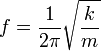
The natural frequency of the building can
be calculated by using the formula:
where K is the stiffness constant of the
building and M is the mass of the building. Structures can be both reinforced horizontally and
vertically, by using: diaphragms, trussing, braced frames, shear walls and
moment resisting frames.
However structural reinforcing and engineering is not the
only way in which Japan is reducing the damaged caused by earthquakes. They
have installed my pre-earthquake warning systems such as sirens that allow
people such as school children to prepare for the imminent tremors by doing
things such as hiding under desks or gathering in areas that should be safest
from falling debris and collapsing buildings.
Another way in which Japan try
and prevent catastrophes during earthquakes is by shutting down core reactors
in nuclear power plants to avoid meltdowns and radiation related
disasters.
The way in which Japan is now prepared for the threat of
earthquakes has not always been the case and much of the planning and building
regulations for “earthquake safe” buildings only came in after the Kobe
earthquake in 1995. During which over 6,400 people lost their lives and
thousands of homes were destroyed.
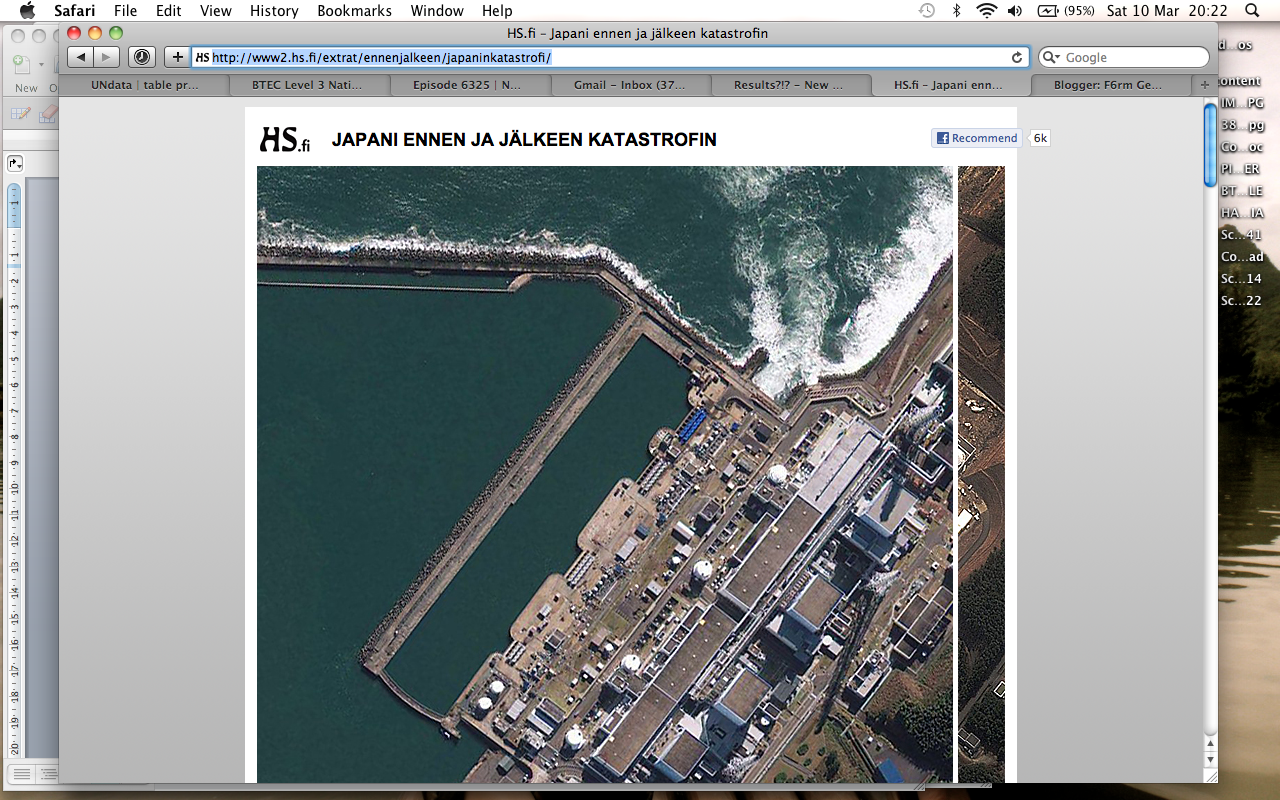
Check out these amazing photos of Japan before and after the Tsunami. You can use your mouse to switch between photos which allows a really interesting comparison. The first link shows aerial views before and after the tsunami struck, while the second link shows the clean up operation one year later.
Were there any early warning systems for the earthquake?
Yes. There was a national system installed on 2007 to warn people of earthquakes and this system gathers information from over 1000 seismographs from around japan. After an earth quake is detected the system automatically sends out a warning after on 8.6 seconds of first detecting the earthquake.
It sends warning messages via a number of different ways such as through automatic messages on TV, through the mobile phone network and radio.
Were there any early warning systems for the tsunami?
Yes. There is a chain of tsunami buoys around the pacific that detect tsunami’.
But it takes longer to detect tsunami’s, around 8 minutes, so many places only had around 15 minutes of warning before it hit.
Were there defences against a tsunami?
Yes. At least 40% of japans 22,000 miles coast line is lined with concrete sea walls, break waters and other structures that are meant to reduce the impact of high waves and an tsunami.
But many of these seawalls and structures were inadequate and were effected by japan sinking one meter after the earthquake.
The Kamaishi Tsunami Protection Breakwater, 1,950 m (6,400 ft) long and 63 m (207 ft.) in depth, was completed in March 2009 after three decades of construction, at a cost of $1.5 billion. It was the world’s deepest breakwater. But this did not help against the tsunami and over 1300 people have been killed or are missing.
Were the buildings protected against the threat of an earthquake?
Yes. After the Kobe earthquake in 1995 became a world leader in engineering against earthquakes for new structures and the retrofitting of old buildings to protect them against earthquakes.
Strong Japanese building codes specify rules for short, medium and tall buildings.
New buildings shorter than three stories are required to have reinforced walls and foundation slabs of a certain thickness.
Mid-rise buildings such as hospitals and laboratories in Japan often rest on huge rubber or fluid-filled shock absorbers.
Many large building have large weights on the top of them which will move to counter any movement of the building.
Buildings were also built with large rubber shock absorbers into their foundations and cross bracing of buildings to help prevent brake up during shaking.
Was there education to prevent loss of life?
Yes. Local authorities issue advice to people on how to prepare for an earthquake by securing homes, appliances and heavy furniture and getting together earthquake kits.
Schools, offices and factories have frequent earthquake drills.
The government and offices observe disaster prevention day, 1st September.
One secondary effect from the Japan earthquake of 11th March 2011 is that debris ended up being washed up on the beaches of other countries. With a limited number of resources to help clean up the earthquake-hit regions, much debris remained scattered around the coastal areas and further inland. As a result, some of the debris that was left along the Japan coastline had been transported, by ocean currents, to areas across the world, such as Tofino, a town on Vancouver Island. Local residents from Tofino had seen Japanese water bottles being washed up on the town’s beaches on 28th December 2011, over nine months after the earthquake disaster. Other items washed up on the beaches included socks and toothbrushes, as well as lumber with Japanese export stamps on it.
Some of the debris washed up on the beaches of Tofino, Vancouver Island.
Another secondary effect from the Japan earthquake was that dangerously high levels of radiation had been recorded in the water at one of the reactors of the earthquake-hit Fukushima Daiichi power plant. The tsunami, which occurred as a result of the earthquake, damaged power supply cables, disabling the power supply and resulting in the cooling of the three reactors. Many weeks had passed of focused work to restore power to the Fukushima Daiichi power plant, enabling heat to be removed from the reactors.
The earthquake also had a huge effect in the business industry, with first-quarter profits in 2011 falling slightly of market expectations for the firm Coca-Cola. The United States’ drinks firm made £1.15bn in the first three months of 2011, up by 18% from 2010. However, earnings were still 1% lower than expected because of lost revenue from Japan, where sales suffered as a result of the earthquake and tsunami. With many buildings damaged or flooded by the tsunami, shops were closed and customers couldn’t buy products, such as coca-cola products.
Furthermore, aftershocks from the earthquake were also a secondary effect. On Thursday 7th April 2011, a reported 7.1 magnitude earthquake struck north-east Japan. Several buildings were damaged, power was cut to 3.6million homes and three people lost their lives. It was the most powerful aftershock since the earthquake on 11th March 2011.
Where: The earthquake occurred 250 miles off the North East Coast of Japan's main island Honshu.
The Response:
116 countries and 28 organisations offered assistance to Japan. Even Afghanistan with a very low GDP donated $50000 to the disaster. Indonesia, which was the worst hit country in the 2004 tsunami, sent rescue workers, medical assistance and supplies. Indonesia's Government also donated US$2 million. Taiwan provided over US$243 million, the highest amount in the world, in aid from the government and public combined. Taiwan also hosted a fundraising concert that raised $26 million for the disaster. Thailand also alone donated approximately $6.6million as well food and other necessities. The UK sent 70 rescuers to Japan, including two search dogs, a medical support team and 11 metric tons of specialized rescue equipment. Many NGO’s also got involved providing aid for the disaster.
"Japan is not Haiti and it's not Indonesia, it's a developed country with a GDP somewhat similar to our country. It's not what people typically think of as a country in need of wide-scale international aid," said Daniel Borochoff, president of the American Institute of Philanthropy.
Immediate Responses:
· In freezing temperatures survivors huddled together in shelters and hoarded supplies as rescue workers searched the coastline to search for any survivors in the rubble.
· Helicopter crews looked for survivors on rooftops and flooded farmland.
· 100000 soldiers assigned to establish order, organise rescue work, and distribute blankets, bottled water, food, and petrol.
· Offers of aid poured in from other countries, including China and the USA.
· An exclusion zone was set up around the Fukushima nuclear plant. Homes were evacuated and iodine tablets, to prevent radiation sickness, were distributed.
· There were no reports of looting or violence.
Long-Term Responses:
· Japan coped well with the earthquake. But the tsunami defences were inadequate against the extreme height and force of the water. Future planning and important decisions will have to be made to reduce the risk of this scale of devastation happening in the future. (Move settlements further inland, avoid building in this area, improved defence systems to reduce the effect of a future disaster.)
· Grievance from deaths of family members and friends, and many people who have lived there for generations have had to leave their homeland behind. The aid has helped people financially to receive basic necessities, in times of suffering.
· Japan will have a big price to pay for the disaster. The country was already the most heavily indebted in the industrialized world and the repair bill will have to be raised by more government borrowing. Private companies also faced heavy costs. Japan is an economically developed, rich country so will find it easier to recover than many less economically developed countries, such as Haiti.
On March 11th 2011 at 2.46pm, Japan was hit by its largest earthquake in history with a magnitude 9 on the Richter scale (previously the largest was 8.4 on the Richter scale) the same as around 2 million atomic bombs!
The earthquake is believed to be caused by a sudden movement, releasing the hundred years of tension generated by the Pacific plate subducting under the Eurasian plate. The earthquake was so large it shifted Japan 3 metres out to sea, dropped the Japanese coast over a metre and even knocked the earth off its current axis by 25cm, shortening the day by 1.8 micro seconds. The epicentre was located 100km off the coast of Sendai and the focus was 6km deep. The earthquake hit Sendai first with its P waves travelling at 6km a second and the always slower S waves travelling at 3km.
The earthquake affected all of the Eastern coast of Japan, taking around 100 seconds to reach its capital Tokyo and created ground shaking which lasted around 5 minutes, an abnormal time for an earthquake. Massive cracks were visible in the ground and during the shaking the ground was even seen to be expanding and contracting due liquefaction in some areas. Liquefaction occurs when the shaking of saturated sediment squeezes water to the surface.
Due to an epicentre located in the sea, and such a large explosion of energy from the earthquake a tsunami, over 10 metres high was created. The deep ocean and the massive moment meant the tsunami travelled at speed of 60kmph, taking only an hour to reach the coast. The tsunami, hitting Ofunato first then Sendai then Miyako, was superior to tsunami defences such as sea walls which had been weakened by the dropping of the coastline.
The tsunami is believed to have travelled up to 10km inland depending on the topography of the land, with flatter land allowing the tsunami to travel faster. In more developed places the water was seen to reach even higher height due to being squeezed between and over buildings. The tsunami travelled in both directions, toward Japan and out into the Pacific ocean, where places such as Hawaii receiving waves of 1 metre high.
Over 500 aftershocks were recorded during the week after the earthquake with some shakes, such as the one that killed 3 people and injured many others on 8th April, reaching a magnitude of 7.1. The map above (from the USGS) shows the sheer number of after shocks that have occured. Scientists have warned that Japan may face years of aftershocks as the fault continues to adjust and settle to its new position and pressures.
Liquefaction has been a feature of both Christchurch earthquakes, seen as tonnes of silt on the roads and sand volcanoes or sand boils on people’s lawns. This video shows what was happening under the surface of Christchurch during the earthquake.
Isn’t wonderful what a private citizen can teach with a spade, a wheelbarrow, some cobblestones, and a video camera. How many thousands would it have cost taxpayers like yourself if a government department was told to produce an equivalent demonstration?
The video is great, but ever since the earthquake I’ve wondered what was happening inside the soil during liquefaction. Make yourself comfortable while I explain it in plain English…
If you’re filling a jar with sugar and want to fit as much as possible into the jar you stop part way and shake the jar in order to create some empty space at the top. When you shake the jar the grains of sugar rearrange themselves so they can snuggle up closer and the size of the empty spaces between the grains is reduced.
Much of Christchurch is built on sandy soil and if that soil was perfectly dry an earthquake would shake the sand, the soil would settle like the sugar in your jar, and buildings would crack as they moved downwards to the new soil level*.
However, the sandy soils of Christchurch aren’t perfectly dry and there is water sitting between the grains of sand. The soil is like an old fashioned sponge which has lots of empty spaces that can hold water. When you squeeze a wet sponge you reduce the size of the spaces that hold water. The water is incompressible (it cannot become smaller in response to squeezing) and will not fit into the smaller spaces. When your house is too small you move out, and in a similar way the water moves out of the sponge. When you go the beach and stand on the sand just above the water’s edge you’ll soon find yourself standing in a puddle because your weight has squeezed the water out of the sand.
When a sponge has been squeezed gently the water moves out like water coming out of a garden hose, and when the sponge has been squeezed hard the water moves out like water coming out of a fire hose. Squeezing harder increases the water pressure.
Back to the soils of Christchurch. As the damp, sandy soil is shaken and settles like sugar in a jar the water between the grains is squeezed by the weight of the sand, buildings, roads, etcetera above it. In response to this squeezing the water wants to move out of the sand, but before it has a chance to do that another vibration from the earthquake causes more squeezing. More squeezing causes more water pressure, and two things happen:
1) The increased water pressure greatly reduces the forces that hold the sand grains together. To put it another way, as the water pressure increases each grain of sand finds it harder and harder to hold onto his neighbours. Eventually the water pressure reaches a point where the grains of sand cannot hold hands at all: now the soil has no internal structure and flows like a liquid. Liquefaction has occurred.
A tent with a frame inside it illustrates this. When the tent is set up properly is has shape and is strong. Take away the frame, which is the tent’s internal structure, and the tent collapses. When you take away the tent’s internal structure it goes from being a solid object to an object which flows like liquid. When you watch the video above you can see the sandy soil collapsing much like a tent.
When liquefaction occurs buildings drop down because they are no longer sitting on solid ground, just as the beach sand makes you unstable when you are standing close to the water’s edge.
2) As the shaking of the earthquake increases the water pressure the soil becomes like a little kid who is busting to go to the toilet. The water desperately wants to get out of the soil – just as it desperately wants to get out of a squeezed sponge – and the only way out of the soil is up. When this happened in Christchurch people saw water sitting on top of the ground, much like water sits on top of the beach sand as described above. As the water moves up it carries sand with it and the people of Christchurch saw sand volcanoes (also known as sand boils) and tonnes of sand on the streets.
It’s much like popping a pimple: your squeezing increases the pressure of the pus so that it takes the only exit and hits the mirror .




 .
.
